Showing posts with label bees. Show all posts

Monday, November 18, 2019

Bees

Last November I mentioned that our bee hives did not survive winter in 2018. I also mentioned that we had two new hives from a bee-keeper in Geelong. One of those hives was weak and did not thrive, but the other one survived. However they hadn't managed to store much honey before winter, so we had to feed them to keep them alive until spring. The feeding seemed to work, as there were bees going in and out of the hive when the weather was warm enough. I haven't been near the hive recently, but the garden has had plenty of bees in it as spring has progressed.

Today is warm and not raining, so a good day to open the hive and check on the bees. We thought they could be running out of room and need another super to expand into.

However this is the confronting reality:

No bees at all! Whether they have swarmed away, or died since the end of winter, I don't know. But I think that is the end of our bee-keeping efforts.

Monday, November 11, 2019

Insects in Flowers

This is Pollinator Week, so here are a few insects in flowers.

 Bees busy in the pigface:

Hoverfly in a Californian poppy:

A horehound bug on lavender:

Another horehound bug on borage:
Horehound bugs, Agonoscelis rutila, are a puzzle. They are native to Australia, but according to the internet aren't found on native plants. They suck the sap of horehound, which is a non-native weed. So what did they eat before horehound arrived? Something doesn't add up. And where did they come from to be on our lavender and borage? Lavender is at least in the same family as horehound, but borage isn't. Perhaps the internet is wrong! 

Finally, some Mesembryanthemum with no visible insects:
There were some small native bees buzzing around them, but I didn't manage to get any photos of them.

Sunday, November 11, 2018

Bees Like Peonies

Three bees in a peony flower.

Neither of our bee hives made it through the winter, which was very sad. But these bees are probably ours anyway, as we have two newly-established hives which came from a bee keeper in Geelong.

Sunday, December 31, 2017

Year's End

Today was a quiet day. I spent a bit of it on the treadle machine, joining units for the current mystery quilt. Bonnie surprised me by adding another clue this morning, on top of yesterday's which I had only cut out but not sewn. Anyway, I am all up to date now. I wouldn't be surprised if there is another clue, possibly even the reveal, tomorrow.

Just as I finished sewing, one of our beehives swarmed. That was unexpected, as this hive has only been here since spring, after being captured in Geelong. They seemed happy last time they were looked at, and they had lots of space for growth and honey storage in their current hive.

Fortunately they settled quite low to the ground, in a small blackwood:

While a box was being prepared to catch them in, they moved to a young eucalypt a few metres away:
Still within reach, fortunately. If they had settled in one of our large trees we would have no hope of retrieving them.

New box:

Snip the branch the bees are hanging from, and drop them into the box:

Once they are all in, put the lid on, and wait to see if they will stay in.
In fact they don't seem to want to stay in that box.

Here's how they looked a couple of hours later:
Bees all over the outside of the box, rather than being inside setting up home. The second box on the right was to see if they might just prefer a different one. (The black and white thing in the top right is a magpie taking off).

It is now another 90 minutes or so later, and they are still on the outside of the box. But the sun is setting and it is too late to try anything more with them tonight. We'll see where they are in the morning.

Happy new year, everyone!


Wednesday, April 19, 2017

Evening Expedition

Misty evening in Ocean Grove:

Visiting at this time of day so that we could collect the two bee hives and bring them here.

Friday, July 8, 2016

Feral Bees

Took the dogs out for a walk in the sunshine. They've missed their walk for the last few rainy days.

Just down the road some bees circling around drew our attention to this:

We must have walked past here a hundred times, but never before noticed this colony of bees living in a tree stump beside the road. Perhaps that's because we don't normally go out walking in the middle of the day?

A closer look:

I couldn't get too close. They are bees, after all! But this seems to be a very exposed place to set up home. I'll be surprised if the colony survives the winter. Unless there is an enormous reserve of honey further inside the stump, I don't think the bees will have enough energy to keep the core of the colony at 36 degrees when the air outside is below zero at times, and not very warm for the rest of the time.


Tuesday, January 12, 2016

Crepe Myrtle

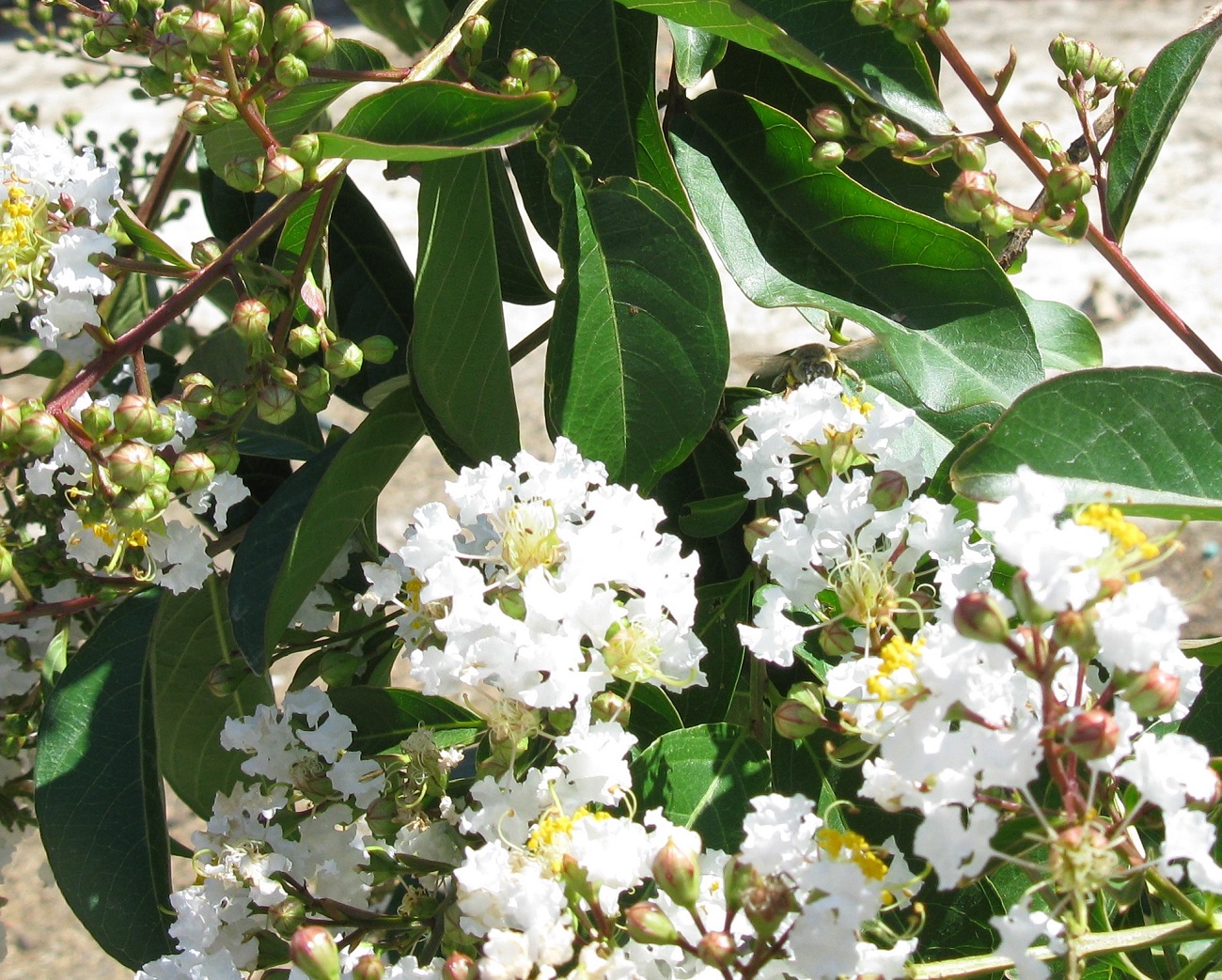
One of the crepe myrtles is in flower:
As I walked past I noticed loud buzzing. There were a couple of honey bees in it, but most of the buzzing was coming from a native blue-banded bee. Can you see it in the photo above?

What if I zoom in:
Could be anything, couldn't it? Will have to try harder to get a picture of the blue bands!

Thursday, August 21, 2014

Checking the Hives

A warm sunny day gave us the opportunity to check on the bee hives.

The first hive has two supers without a queen excluder, and the queen has been busy laying lots of new babies throughout the hive:
There is very little stored honey, as the bees have been feeding thousands of larvae. This photo shows a little stored honey around the top edge (the pale yellow cells), lots of capped brood (the darker yellow cells), and some larvae almost ready to be capped (the whitish cells towards the bottom). The dark cells in the centre are where baby bees have already emerged, and most of them have a new small larva developing in the bottom of the cell. There are lots of bees on the frame, caring for the larvae.

It wasn't warm enough today to pull the whole hive apart, but I suspect there could be some queen cells somewhere in this hive, and these bees are getting ready to swarm in spring. Today we added an empty third super above a queen excluder, to give them some honey storage space. Will that stop them swarming?

The second hive is very different. This one has a queen-excluder between the first and second super, which means the queen can only lay eggs in the bottom half of the hive. Contrast this frame from above the excluder with that from the first hive:
This one is full of honey. There are few bees on it because there isn't much for them to do once the honey cell is full and capped. The whole top super was pretty full of stored honey. We removed four full frames and replaced them with empty ones, and also added a third super with eight empty frames. So this hive now has lots of available storage space for honey. Will they want to swarm, or will they be happy filling up the hive again?

What happens to these two hives over the next few weeks will be interesting, and could influence how we set the bees up for future winters.

Friday, October 4, 2013

Pollination of a Weed

Spanish broom, Spartium junceum, grows along the road in places at Lal Lal, despite previous weed control measures. Today I saw how bees help it along:
Bee pollinating Spartium junceum
As the bee pushes into a flower to get to the nectar, the stamens and stigma spring up and curl over the bee. The stamens shower the bee with pollen. You can see how orange the hairy parts of the bee look because of their coating of pollen., and if you enlarge the photo you can see pollen flying into the air on the left.  Meanwhile the stigma touches the bee's back, to pick up pollen already there from another flower. This bee also has a good collection of pollen in her pollen baskets (the orange lump on her hind leg), to take back to the hive to feed baby bees.

Tuesday, September 17, 2013

Extra Room

Six frames of honey were removed from my bee hive about a month ago. Today when the hive was opened again, the bees had almost filled the empty frames. They've been very busy during the blossom season. So it was time to give them some room to expand into:
An extra super added to the hive today. That's eight empty frames for them to start work on.

Friday, May 24, 2013

Buzzing

As I walked under this nearby street tree today, I was surprised to hear bees buzzing.
The bees had noticed something I had missed; the tree is covered in tiny flowers:
It's only a week to winter, but when the sun shines like it did today there is plenty of food for the bees to gather close to home.

Friday, May 17, 2013

Chilly

Tree dahlias flowering in my garden:
They provide lots of food for the bees, but it was a bit cold today for them to take full advantage of it. Here's one brave worker out on her own:
I followed the bees' example and stayed inside most of the day, keeping warm by doing some quilting.

Wednesday, April 10, 2013

Bees Like Palms

Spotted this morning:
Palm tree (probably Canary Island palm Phoenix canariensis) in flower, attracting lots of bees.

Friday, March 1, 2013

Happy Autumn

Some of my bees visiting very Autumnal-looking gaillardia Fanfare Blaze plants at the hardware warehouse over the road.

Monday, February 11, 2013

Indigo Spires

I think my front garden looks best in February. Lots of plants are blooming, and many of them are attractive to my bees:
Bee gathering nectar from salvia "Indigo Spires".

Wednesday, January 30, 2013

Busy Day

My bees were very busy today, visiting lots of flowers in my garden.
This one is gathering pollen from a crepe myrtle. The largest lump of pollen in the picture is actually the bee's pollen sac.

I finished attaching hanging tabs to this wall-hanging,
so now it is officially complete. The pattern was designed by Margaret J. Miller, who called it "Whirlin' Dervish".  I thought of a good name for mine the other day, and I wish I had written it down at the time! This afternoon I made a few QAYG blocks to use up the excess backing fabric and batting I trimmed from this piece before binding it. Then I crossed this hanging off my list of unfinished projects, and tried not to look at how long the list still is.

Saturday, December 22, 2012

Easy Street - Step Five

The Brush Box (Lophostemon confertus) street trees are in flower and full of bees. Each tree hums loudly from dawn to dusk. Last time I mentioned them, I hadn't been able to get a shot of a bee, but today I managed one:
Bee in Lophostemon confertus
Don't know if it is one of my bees, but it could be.

After that walk, I made a few of the next units of the Easy Street mystery:
Easy Street Mystery - Step Five
I'm glad this step used purple and aqua, as I found a few more fabrics of each of those colours this week which weren't where they should have been, so now I've had the chance to add in some of each.
There's a few more units to do, but they will have to wait a while. I've got some other sewing to complete first.

As usual, I'll add the link to everyone else once it is available. Here it is!

Thursday, November 29, 2012

Desperate Bees

Desperate for water, that is. As I was leaving work today it was 39 degrees outside. This potted plant had attracted large numbers of bees:
On some leaves they were on the top surface, and on others they were underneath. Were they gathering water? I thought so at first but maybe it was just that the leaves were cooler than the air and they were resting, because this was about two metres away:
A trickle of water from a drainpipe attracting hundreds of bees. Beekeepers make sure their bees have water available, but these may be feral bees. They need the water to cool their hive on hot days, to keep the internal temperature at 35°C. They spread water around so that as it evaporates it cools the hive. On a day like today, that takes a lot of work.

Tuesday, October 23, 2012

Moving

After dark tonight, one of the captured swarms took a short car ride and was placed on top of the hive in my back yard. The existing hive has no queen in it, so all the bees will eventually die out.
When that happens, the new hive on top will replace it. For now, you might just be able to see a few of the new bees venturing out once their entrance was re-opened after the journey.

Saturday, October 20, 2012

Too Many

I've lost count of how many swarms there have been so far this spring. Six? Seven?
And here's another one.

Whatever the total, it is too many! However, a couple of the hives have swarmed once too often, and now appear to have no queen. So the swarms we've caught will take over the queenless hives, and not add to the total number of hives. We're fine as long as there are no more swarms...